How DLSS Controls Grain Size for Austenitic Stainless Steel Tubes – Why It Matters

DLSS - Pipe&Tube - How DLSS Controls Grain Size for Austenitic Stainless Steel Tubes – Why It Matters

Meta Description:
Discover why grain size matters in stainless steel tubing and how DLSS ensures optimal grain structure through precise heat treatment, testing, and quality control.


Introduction

Grain size in stainless steel is more than just a microscopic characteristic—it directly affects mechanical strength, corrosion resistance, formability, and creep performance.

For critical applications such as heat exchangers, nuclear power, and chemical processing, maintaining the correct grain size (typically ASTM No. 5 to No. 8) is a specification requirement and a quality benchmark.

At DLSS, we take grain size control seriously—integrating it into our heat treatment programs, testing protocols, and material traceability system.


1. Why Grain Size Matters in Stainless Steel Tubes

Grain size impacts austenitic stainless steel in the following ways:

  • Finer grains (No. 7–8):
    • Better ductility and formability
    • Enhanced resistance to intergranular corrosion
    • Preferred for U-bend tubes, instrumentation tubing, nuclear heat exchangers
  • Coarse grains (No. 3–4):
    • Higher tensile strength
    • Lower ductility
    • Susceptible to sensitization and stress corrosion cracking in weld heat-affected zones (HAZ)

Reference: ASTM E112 – Standard Test Methods for Determining Average Grain Size


2. Industry Standards & Customer Requirements

Grain size is commonly referenced in:

  • ASTM A213 / A269 (Seamless and welded tubes for heat exchangers and condensers)
  • EN 10216-5 (For pressure purpose stainless tubes)
  • EDF RCC-M / ASME Section III (Nuclear industry specifications)
  • Client TDCs from power, chemical, and desalination projects

Typical required range: ASTM No. 5–8 (with average size controlled and documented)


3. How DLSS Controls Grain Size

A. Solution Annealing Parameters

  • Conducted at 1050–1150°C, holding time adjusted based on wall thickness and alloy type
  • Rapid quenching (water or inert air) prevents carbide precipitation and grain growth
  • Furnace temperature and cycle data fully recorded

B. Material-Specific Programs

  • TP316L, TP321, TP347H: Precise time-at-temp control to prevent coarse grains
  • Nickel alloys (Incoloy 825, Alloy 625): Dual-phase structure stabilization
  • Duplex grades (S31803, S32750): Ferrite-austenite balance with fine grain uniformity

C. Post-Bending Heat Treatment for U-Tubes

  • Re-annealing after U-bending restores original grain size
  • Grain structure in the bend area is evaluated using etched samples

4. Grain Size Testing at DLSS

  • Standard: ASTM E112 (Comparison and Intercept Methods)
  • Frequency: Per heat batch and every lot for critical projects
  • Tools: High-magnification optical microscope with calibrated grain charts
  • Optional: Microstructure photo archive and digital reports for clients

Learn more about grain size testing: NDT Resource Center – Microstructure Testing


5. Real-World Example:

Project: TP316L BA Seamless Tubes for Pharmaceutical Condenser
Issue: Client specified minimum ASTM No. 6 grain size
DLSS Solution:

  • Adjusted annealing dwell time + water quench
  • Conducted grain size testing and provided photo evidence
  • Third-party inspection (SGS) verified compliance
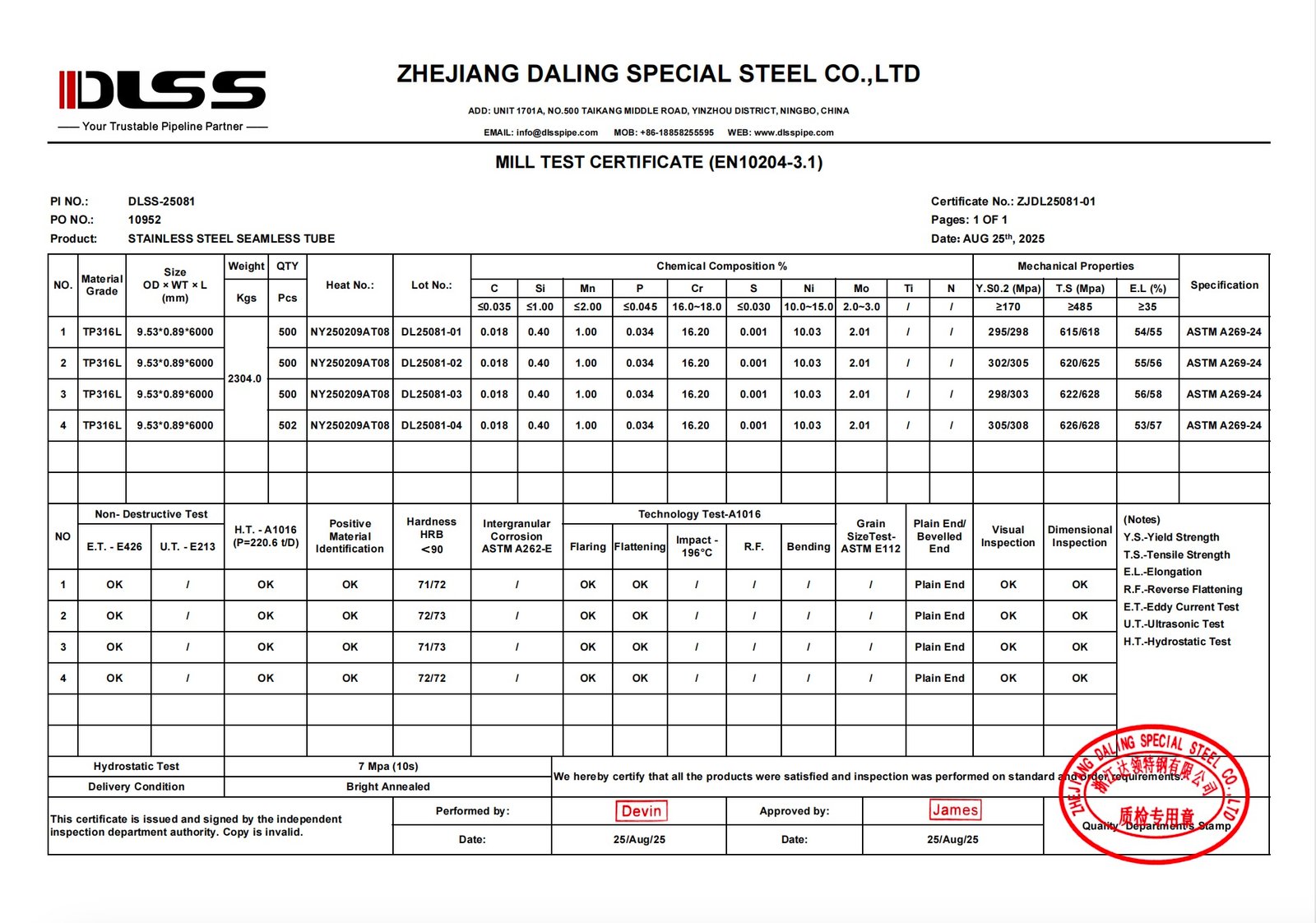
  • Delivered tubes passed visual, hardness, PMI, and grain size requirements

Result: DLSS approved as long-term supplier for GMP-grade stainless tubing.


6. Summary Table – DLSS Grain Size Control Scope

GradeTarget Grain Size (ASTM No.)Process ControlNotes
TP304L / TP316LNo. 6–8Solution annealing + water quenchFor general & pharma applications
TP321 / TP347HNo. 5–7Stabilized annealingFor high-temp, creep-resistant usage
S31803 / S32750Duplex structure, fine grainBalanced heat cycleAvoid intermetallic phases
Incoloy 825No. 5–7Controlled coolingFor chemical & H₂SO₄ service

Conclusion

Grain size control is an essential part of stainless steel tube manufacturing—particularly for demanding industries that require formability, corrosion resistance, and thermal stability.

DLSS integrates grain size verification into our heat treatment, testing, and documentation process, ensuring every tube meets your performance expectations and project specifications.


Contact DLSS
Email: info@dlsspipe.com
Website: www.dlsspipeline.com

Need a stainless tube supplier who understands the details that matter? DLSS delivers more than just tubes—we deliver performance you can verify.

Wonderful! Share This Case:

Austenitic Stainless Steel

Duplex Stainless Steel

Nickel Alloys

▪ Incoloy Family

▪ Inconel Family

▪ Monel Family

▪ Hastelloy Family

▪ Other Special Alloys

Cobalt Alloys

Related Posts

ASTM A269 vs ASTM A213: What’s the Difference for Stainless Steel Tubes?

ASTM A269 vs ASTM A213:

Meta Description:Confused between ASTM A269 and ASTM A213 stainless steel tube standards? This guide compares their differences in application, mechanical properties, testing, and surface finish. Introduction When sourcing stainless steel tubes, understanding the applicable ASTM standards is crucial. Two commonly referenced specifications are ASTM A269 and ASTM A213. While they may seem similar, these standards […]

Read More
316 vs 316L vs 316Ti stainless steel

316 vs 316L vs 316Ti

1. Overview In demanding industries such as heat exchangers, condensers, boilers, and pressure vessels, stainless steels of the 316 family are among the most widely used materials. However, choosing between 316, 316L, and 316Ti depends on factors like weldability, temperature stability, and corrosion resistance. At DLSS (Zhejiang Daling Special Steel Co., Ltd.), we supply all […]

Read More
ASTM B111 C70600 (O61) Copper-Nickel Seamless Tube 16 × 1.0mm × 3000mm with 100% Eddy Current Testing for Condenser Applications

ASTM B111 C70600 (O61) Copper-Nickel

Product Overview: ASTM B111 C70600 Seamless Copper-Nickel Tube (16×1.0mm, 3000mm) C70600, also known as 90/10 Copper-Nickel, is a marine-grade copper alloy containing 90% copper and 10% nickel. It’s renowned for its outstanding resistance to seawater corrosion, biofouling, and stress corrosion cracking, making it a top choice for condenser tubes and heat exchanger systems, especially in power plants, […]

Read More
europe-cbam-stainless-steel-export-guide

How Europe’s CBAM Is Changing

On October 1, 2023, the European Union launched its Carbon Border Adjustment Mechanism (CBAM) — a groundbreaking policy that requires importers to report the embedded carbon emissions of certain goods, including iron, steel, and stainless steel. For stainless steel pipe and heat exchanger tube exporters, this marks a new era. Quality and price are no […]

Read More
How to Improve Heat Exchanger Efficiency: Practical Tips for Better Heat Transfer Performance

5 Proven Ways: How to

1. Introduction – How to Improve Heat Exchanger Efficiency How to improve heat exchanger efficiency is a key question for operators who want lower energy bills, stable output, and longer asset life. Whether you run a shell and tube heat exchanger, a plate heat exchanger, or an air-cooled design, optimizing heat transfer performance delivers a […]

Read More
Top 10 Applications of Stainless Steel Tubes in the Oil & Gas Industry

Top 10 Applications of Stainless

Meta Description:Explore the top 10 critical applications of stainless steel tubes in the oil & gas industry. Learn how DLSS tubes perform under high pressure, corrosion, and extreme conditions. Introduction The oil and gas industry operates under extreme conditions—high pressure, corrosive environments, and fluctuating temperatures. To ensure safety and durability, stainless steel tubes are essential […]

Read More
Top Surface Finishes for Stainless Steel Tubes – BA, EP, Polished, and More

Top Surface Finishes for Stainless

Meta Description:Discover the most common surface finishes for stainless steel tubes—BA, EP, polished, pickled—and how each impacts corrosion resistance, cleanliness, and application suitability. Introduction Surface finish plays a critical role in determining the performance and aesthetics of stainless steel tubes, especially in industries like pharmaceuticals, food processing, heat exchangers, and instrumentation systems. Whether your project […]

Read More
Europe’s Stainless Steel Tube Market: Compliance-Driven Demand and Strategic Opportunities

Europe’s Stainless Steel Tube Market:

Europe is one of the most regulated and compliance-focused markets in the world for stainless steel seamless tubes—especially for heat exchangers, pharma-grade piping, and energy infrastructure. With stringent requirements for traceability, environmental certification, and dual material standards, suppliers must demonstrate not only high product quality but also full alignment with EU directives. In this blog, […]

Read More

Request A Quote

*We respect your confidentiality and all information are protected.