Understanding Pickling and Passivation in Stainless Steel Tube Production

DLSS - Pipe&Tube - Understanding Pickling and Passivation in Stainless Steel Tube Production

Meta Description:
Learn how pickling and passivation improve corrosion resistance in stainless steel tubes. Explore DLSS’s cleaning methods, ASTM standards, and industry-specific applications.


Introduction

Even the highest-grade stainless steel can suffer from surface contamination during tube forming, welding, or heat treatment. To restore the full corrosion resistance of stainless steel tubes, manufacturers must apply pickling and passivation processes—two chemical surface treatments essential to durability and cleanliness.

At DLSS, we apply both treatments as part of our tube finishing process, in accordance with international standards like ASTM A967 and EN ISO 16048, ensuring a clean, passive surface ideal for demanding environments like heat exchangers, food processing, and oil & gas pipelines.


1. What Is Pickling?

Pickling is a chemical treatment used to remove oxide scale, welding discoloration, and embedded iron particles from stainless steel surfaces.

  • DLSS uses nitric acid + hydrofluoric acid or citric-based formulations for safer, eco-friendly pickling.
  • Common targets:
    • Heat tint (from annealing or welding)
    • Black oxide (from hot rolling or forming)
    • Embedded carbon steel particles

Reference: ASTM A380 – Standard Practice for Cleaning, Descaling, and Passivation

Keywords: pickling stainless tube, oxide removal, nitric acid HF cleaning


2. What Is Passivation?

Passivation is the process of applying a mild oxidizing acid (typically nitric or citric acid) to:

  • Remove free iron from the surface
  • Allow formation of a stable chromium-rich oxide layer
  • Enhance corrosion resistance in chloride and acidic environments

Passivation does not remove scale or heavy discoloration—hence, it is always performed after pickling, not as a substitute.

Learn more: ASTM A967 – Passivation of Stainless Steel

Keywords: passivated stainless pipe, ASTM A967 standard, free iron removal


3. Why These Treatments Are Crucial

StepEffectBenefit
PicklingRemoves scale and contaminantsPrevents localized corrosion and rust
PassivationForms chromium oxide protective filmRestores natural corrosion resistance

Industries that demand passivated stainless steel:

  • Pharmaceutical and biotech tubing
  • Heat exchanger systems (especially for seawater)
  • Food-grade piping (dairy, brewing, beverage)
  • Nuclear and power plant condensers

4. DLSS Pickling & Passivation Workflow

  1. Visual inspection of tube surface (before pickling)
  2. Immersion or spray pickling using safe, neutralized acid blends
  3. Thorough rinsing with deionized water
  4. Passivation stage with nitric acid or citric acid (per ASTM A967 methods 1–7)
  5. Drying and final inspection, including surface roughness, gloss, and color
  6. Optional: Ferrite test or free iron test (per ASTM A380 water-wetting test)

DLSS can also provide pickled tubes in coil form, U-bend, or cut-to-length with clean ID/OD finish.


5. Surface Condition Options

DLSS offers multiple surface conditions:

Finish TypeDescriptionApplication
Pickled (P)Matte silver, chemically descaledBoilers, pipelines
Bright Annealed (BA)Mirror-like, oxide-freeInstrumentation, clean rooms
PassivatedClean, stable passive layer (invisible)Food, pharma, nuclear
Polished (Grinded)Controlled surface roughness (e.g., Ra ≤ 0.8 μm)Sanitary and dairy tubing

Optional: ISO 15730 – Immersion and spray pickling of stainless steel


6. Real-World Case Study

Client: European pharmaceutical equipment integrator
Tube Spec: ASTM A269 TP316L, OD 25.4 mm x 1.65 mm, 6m
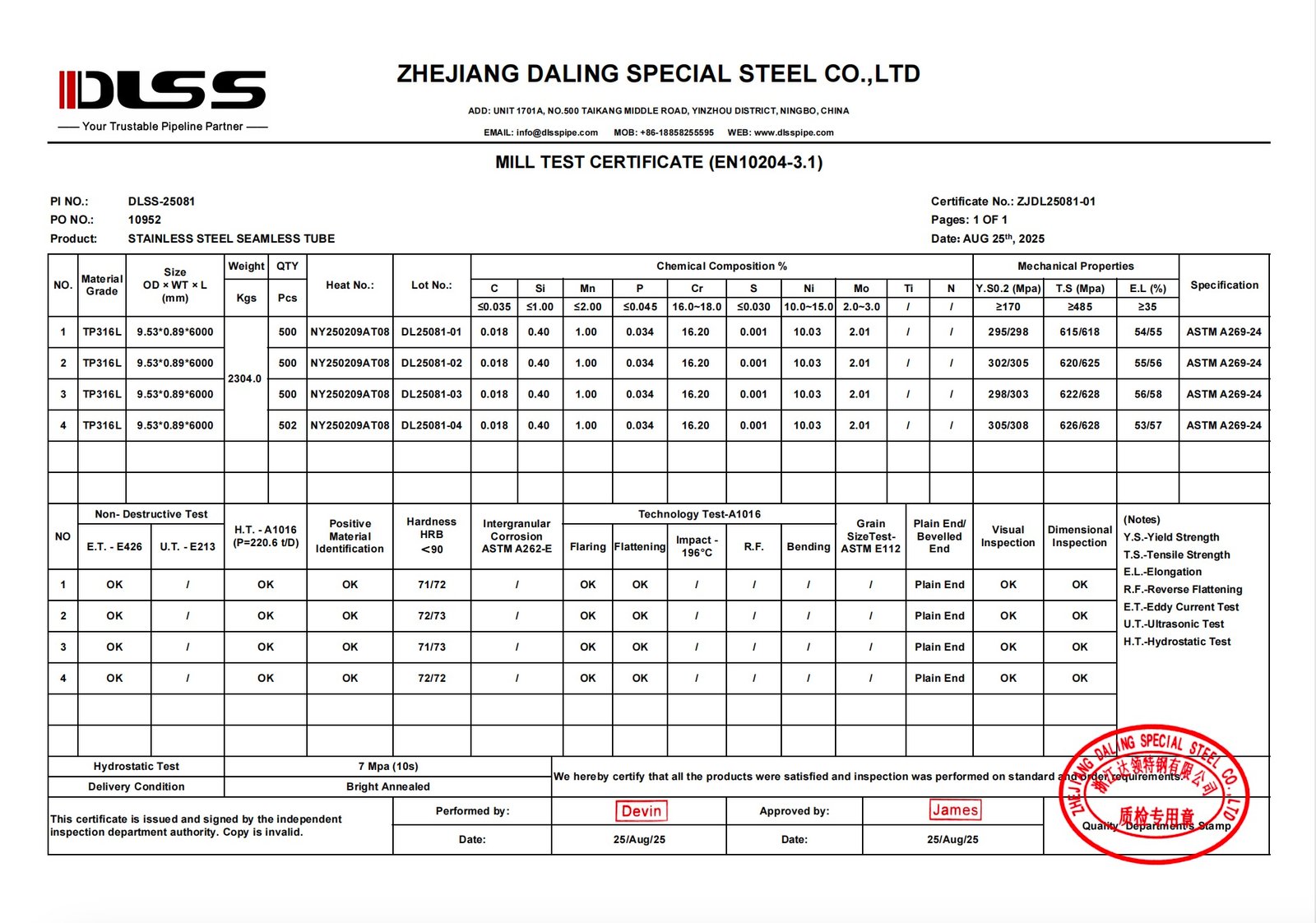
Requirement: Pickled + passivated finish, Ra ≤ 0.8 μm, EN 10204 3.1
Solution:

  • DLSS applied pickling & passivation per ASTM A967, method 1 (Nitric 2)
  • Surface roughness measured using Mitutoyo profilometer
  • Delivered full documentation + third-party SGS witness report
    Outcome: Customer passed FAT and added DLSS to preferred vendor list.

Conclusion

Pickling and passivation are not cosmetic treatments—they are functional, science-backed processes that restore and enhance the corrosion resistance of stainless steel tubes. By adhering to international standards and customizing the process by alloy, DLSS ensures our customers receive tubing that performs from the inside out.


Contact DLSS
Email: info@dlsspipe.com
Website: www.dlsspipeline.com

Have a specification that requires pickling, passivation, or documentation per ASTM A967 or EN standards? Contact DLSS to discuss technical requirements and receive test-certified stainless steel tubes.

Wonderful! Share This Case:

Austenitic Stainless Steel

Duplex Stainless Steel

Nickel Alloys

▪ Incoloy Family

▪ Inconel Family

▪ Monel Family

▪ Hastelloy Family

▪ Other Special Alloys

Cobalt Alloys

Related Posts

belt-road-orders-stainless-steel-tube-strategy

Winning Orders in Belt and

With over 140 participating countries, China’s Belt and Road Initiative (BRI) has become one of the largest infrastructure investment programs in history. From oil pipelines in Pakistan to power plants in Southeast Asia and desalination facilities in Africa, the demand for stainless steel pipes, tubes, and heat exchanger systems is rapidly expanding. For Chinese manufacturers, […]

Read More
How Long Do Stainless Steel Seamless Pipes Last? Lifespan, Factors, and Best Practices

How to Choose the Right

Why Material Selection Matters for Heat Exchanger Tubes In heat exchanger applications, the wrong material can lead to premature corrosion, low thermal efficiency, or even costly shutdowns. Whether you’re designing for a refinery, a desalination plant, or a food-grade chiller, choosing the right stainless steel tube is a crucial step in ensuring durability, reliability, and […]

Read More
middle-east-decarbonization-energy-equipment-procurement

How the Middle East’s Decarbonization

The Middle East, historically known for its oil wealth, is now positioning itself as a leader in clean energy innovation. National strategies like Saudi Vision 2030 and the UAE Net Zero by 2050 roadmap are driving massive investments in hydrogen, solar, desalination, and carbon capture projects. As a result, the region’s energy infrastructure is undergoing […]

Read More
ASTM A213 vs A269: What’s the Difference in Heat Exchanger Tubing?

ASTM A213 vs A269: What’s

Meta Description:Confused between ASTM A213 and A269 stainless steel tube standards? Learn the key differences in application, tolerances, testing, and suitability for heat exchangers and process systems. Introduction Two of the most frequently specified standards for stainless steel tubing are ASTM A213 and ASTM A269. Both cover austenitic stainless steel tubes like TP304L, TP316L, and […]

Read More

How to Select Heat Exchanger

Introduction Heat exchanger tubes are the most critical components in shell and tube heat exchangers. They directly determine the heat transfer efficiency, corrosion resistance, and operational reliability of the entire system. Selecting the wrong tube material can result in serious issues such as: For engineers and procurement specialists, understanding how to properly select heat exchanger […]

Read More
Pickling vs Bright Annealing: Which Surface Treatment Is Best for Stainless Steel Tubes?

Pickling vs Bright Annealing: Which

Meta Description:Pickled or bright annealed? Learn the pros, cons, and applications of these two surface treatment methods used in stainless steel tube manufacturing. Introduction The performance of stainless steel tubes isn’t just about alloy grade or dimensional accuracy—surface finish plays a crucial role in corrosion resistance, cleanliness, and long-term durability. Two widely used surface treatments […]

Read More
Low Finned Tubes in Duplex Steel for High-Efficiency Heat Exchangers

Low Finned Tubes in Duplex

Introduction Heat exchangers play a critical role in maximizing thermal performance across industries such as geothermal energy, petrochemical, and power generation. Among the different tube designs, low finned tubes stand out as a proven solution to increase the surface area and improve heat transfer efficiency without requiring more installation space. Recently, a customer presented us […]

Read More
Meeting JIS G3459 Standards for Stainless Steel Seamless Pipes(JIS G3459規格に適合するステンレス無縫管)

Meeting JIS G3459 Standards for

1. Introduction JIS G3459 seamless pipe Japan is a widely recognized specification for stainless steel pipes used in chemical, food, marine, and high-temperature applications. For Japanese buyers, compliance with ステンレス無縫管 規格 (stainless seamless pipe standards) is not optional—it is the foundation of product acceptance. DLSS ensures every tube meets or exceeds the stringent requirements of […]

Read More

Request A Quote

*We respect your confidentiality and all information are protected.