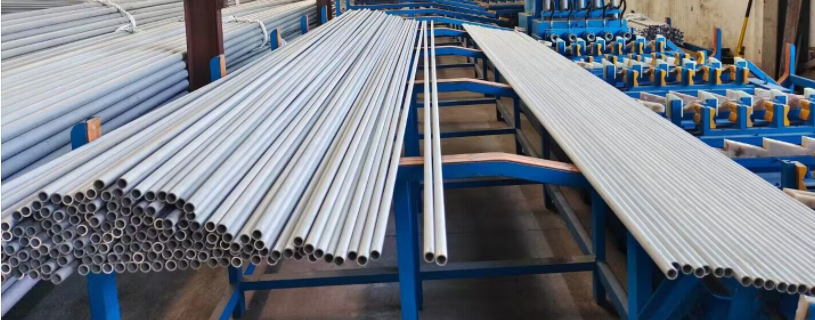
Stainless steel ship piping is used in many marine and shipbuilding systems.
Ships work in a hard environment. The piping may face salt air, seawater, vibration, pressure, heat and long service time. If the wrong pipe material is used, the system may face corrosion, leakage, high repair cost or shutdown risk.
This is why shipyards, marine equipment makers and repair teams must check the pipe material, standard, testing and certificate before placing an order.
There is no one best stainless steel pipe for every ship system. The right choice depends on the medium, temperature, pressure, chloride level, pipe size, welding method, class requirement and project budget.
DLSS supplies stainless steel pipes and tubes for shipbuilding, marine equipment, offshore systems, heat exchangers, condensers and engine room piping projects.
What Is Stainless Steel Ship Piping?
Stainless steel ship piping means stainless steel pipe or tube used in shipboard systems.
It may be used for fluid transfer, cooling, drainage, utility lines, engine room systems, exhaust-related systems, heat exchangers and marine equipment.
Ship piping is different from normal industrial piping. It often needs stricter document control, clear material traceability and class-related inspection.
For shipbuilding and marine projects, buyers should not only ask for “stainless steel pipe”. They should also confirm the system, working medium, pressure, temperature, standard and certificate requirement.
Common Ship Piping Applications
Stainless steel pipes and tubes may be used in many ship systems.
| Ship System | Common Requirement | Material Direction |
|---|---|---|
| Fresh water system | Clean inner surface and corrosion resistance | 304L or 316L |
| Engine room piping | Heat, pressure and vibration resistance | 316L, 321 or project-specific grade |
| HVAC and chiller system | Clean tube, stable size and good corrosion resistance | 304L, 316L or copper nickel |
| Seawater cooling system | Strong chloride resistance | Duplex, super duplex, titanium or copper nickel may be considered |
| Exhaust or scrubber-related system | Heat and corrosion resistance | 316L, 904L, duplex or nickel alloy |
| Bilge and drainage line | Corrosion resistance and easy maintenance | 316L or duplex depending on service |
| Heat exchanger and condenser | Tight tolerance and testing | Stainless, duplex, titanium or copper nickel tubes |
| Offshore marine equipment | High strength and corrosion resistance | Duplex or super duplex |
Why Material Selection Matters
Marine piping faces more risk than normal indoor piping.
Common risks include:
Salt air corrosion
Seawater corrosion
Pitting corrosion
Crevice corrosion
Galvanic corrosion
Weld corrosion
Vibration fatigue
High maintenance cost
Class inspection delay
Wrong material can cause early leakage. It can also delay ship delivery or repair work.
For this reason, the material must be selected based on the real working condition, not only by price.
Common Stainless Steel Grades for Ship Piping
304L Stainless Steel Pipe
304L is a common stainless steel grade. It is easy to source and cost-effective.
It may be used for low-risk shipboard systems, freshwater lines, indoor service or clean utility systems.
But 304L is not a good choice for seawater contact or high chloride service.
316L Stainless Steel Pipe
316L has better corrosion resistance than 304L because it contains molybdenum.
It is widely used in marine environments, but it is not corrosion-proof in seawater. In direct seawater service, 316L may still have pitting or crevice corrosion risk.
316L may be suitable for:
Freshwater piping
Some engine room systems
Low-risk marine service
Equipment piping
Non-critical corrosion service
Before using 316L in seawater or chloride-rich service, the buyer should check the working condition carefully.
321 Stainless Steel Pipe
321 stainless steel has titanium stabilization. It is often selected when the pipe faces higher temperature or welding-related service.
It may be used in some engine room or exhaust-related systems, depending on the design requirement.
904L Stainless Steel Pipe
904L is a high-alloy stainless steel grade. It has better corrosion resistance than 304L and 316L in many chemical and chloride-related conditions.
It may be considered for more corrosive marine or scrubber-related systems.
But 904L is not always the best answer for direct seawater. The real medium, temperature and chloride level still need to be checked.
Duplex 2205 Stainless Steel Pipe
Duplex 2205, such as S31803 and S32205, has higher strength than 316L. It also has better resistance to chloride stress corrosion cracking in many conditions.
It may be used for ship piping when the project needs higher strength and better corrosion resistance.
Common uses may include:
Marine piping
Offshore systems
Seawater-related equipment
Pressure piping
Corrosion-resistant pipe systems
Super Duplex Stainless Steel Pipe
Super duplex grades, such as S32750 and S32760, offer higher strength and stronger chloride resistance than standard duplex.
They may be used in severe marine service, offshore systems and high-chloride applications.
Super duplex is usually more expensive, but it can reduce corrosion risk in critical service.
Stainless Steel vs Copper Nickel vs Titanium
Stainless steel is not always the best material for every ship piping system.
For direct seawater cooling or condenser service, copper nickel and titanium are also common material choices.
| Material | Best For | Main Advantage | Notes |
|---|---|---|---|
| 316L Stainless Steel | Low-risk marine service | Easy to source and cost-effective | Not ideal for severe seawater |
| Duplex 2205 | Higher strength and chloride resistance | Better than 316L in many chloride services | Need project review |
| Super Duplex | Severe marine and offshore service | Strong chloride resistance | Higher cost |
| Copper Nickel | Seawater cooling and marine condensers | Good seawater service history | Common in ship systems |
| Titanium | Severe seawater and condensers | Strong seawater corrosion resistance | Higher material cost |
The best choice depends on the real application. Buyers should confirm whether the pipe is used for seawater, freshwater, oil, air, steam, exhaust gas or chemical medium.
Common Standards for Stainless Steel Ship Piping
Ship piping projects may use different standards depending on the shipyard, owner, class society and end user.
Common stainless steel pipe standards include:
ASTM A312 / ASME SA312
ASTM A358 / ASME SA358
ASTM A790 / ASME SA790
ASTM A269
ASTM A213 / ASME SA213
EN 10216-5
EN 10217-7
JIS G3459
GB/T 14976
For ship projects, the standard alone is not enough. The buyer should also confirm the class requirement, inspection plan and certificate format.
ASTM A312 Stainless Steel Pipe
ASTM A312 is one of the most common standards for stainless steel pipe.
It covers seamless, welded and heavily cold worked austenitic stainless steel pipe.
Common grades include:
TP304 / TP304L
TP316 / TP316L
TP321
TP347
TP310S
ASTM A312 pipe is often used for general corrosive service and high-temperature service.
For ship piping, ASTM A312 is often requested when the buyer needs standard stainless steel pipe with clear material and test records.
ASTM A358 EFW Stainless Steel Pipe
ASTM A358 is used for electric-fusion-welded austenitic stainless steel pipe.
It is often used for larger diameter stainless steel pipe.
ASTM A358 has different classes. Some classes require full radiographic testing, while others have different inspection levels.
This is important for ship projects. If the buyer needs ASTM A358 pipe, the class must be clearly stated in the RFQ.
For example:
ASTM A358 Class 1
ASTM A358 Class 2
ASTM A358 Class 3
ASTM A358 Class 4
ASTM A358 Class 5
Do not only write “ASTM A358 pipe”. The class and inspection requirement must be confirmed.
ASTM A790 Duplex Stainless Steel Pipe
ASTM A790 is used for duplex stainless steel pipe.
It covers seamless and welded ferritic-austenitic stainless steel pipe for corrosive service.
Common grades include:
S31803
S32205
S32750
S32760
ASTM A790 pipe may be selected when the ship piping system needs better strength and corrosion resistance than common austenitic stainless steel.
Seamless vs Welded Ship Piping
Both seamless and welded stainless steel pipes can be used in ship projects.
The choice depends on pressure, pipe size, service condition, inspection requirement and budget.
| Item | Seamless Pipe | Welded Pipe |
|---|---|---|
| Main Feature | No weld seam | Has weld seam |
| Common Use | High pressure, smaller size, critical service | Larger size, general piping, cost-sensitive projects |
| Inspection | UT, ET, hydro test and dimensional check | Weld inspection may be required |
| Cost | Usually higher | Usually more cost-effective |
| Lead Time | Depends on size and grade | Often easier for large diameter |
| Buyer Checkpoint | Size, tolerance, heat treatment | Weld type, RT, hydro test, class |
For critical ship piping, buyers should confirm whether seamless pipe is required by the drawing or class rule.
For large diameter piping, welded or EFW pipe may be more practical.
Pipe vs Tube in Ship Projects
In shipbuilding, both pipe and tube may appear in the same project.
Pipe is often used for fluid transfer systems. It is usually ordered by NPS and schedule.
Tube is often used for heat exchangers, condensers, boilers, HVAC coils and precision systems. It is usually ordered by outside diameter and wall thickness.
| Item | Pipe | Tube |
|---|---|---|
| Size System | NPS and Schedule | OD and wall thickness |
| Common Use | Ship piping systems | Heat exchangers, condensers, coils |
| Main Focus | Pressure and flow | Heat transfer and precision |
| Typical Standards | ASTM A312, A358, A790 | ASTM A213, A269, A789 |
Before ordering, buyers should confirm whether the drawing asks for pipe or tube. This can avoid size mismatch.
Class Society and Certificate Requirements
Ship piping projects may need class-related approval or inspection.
Common class societies include:
DNV
ABS
LR
BV
CCS
NK
KR
RINA
For marine projects, buyers should confirm the certificate requirement at the RFQ stage.
Possible document requirements include:
Material Test Certificate
EN 10204 3.1 certificate
EN 10204 3.2 certificate
Class certificate
Third-party inspection report
PMI report
Hydrostatic test report
NDT report
Dimensional inspection report
Packing list and marking photos
If class inspection is required, the buyer should tell the supplier before production. This helps avoid extra cost, delay or document mismatch.
Testing and Inspection for Ship Piping
Testing is very important for ship piping.
Common inspection items include:
Chemical analysis
Mechanical test
PMI test
Hydrostatic test
Eddy current test
Ultrasonic test
Radiographic test for welded pipe
Visual inspection
Dimensional inspection
Surface inspection
End bevel inspection
Marking check
Document review
For welded pipes, weld quality and NDT requirements should be clear.
For duplex and super duplex pipes, heat treatment and material control are also important.
Surface Finish and End Type
Ship piping may require different surface finishes and end types.
Common surface finishes include:
Pickled surface
Bright annealed surface
Polished surface
Blasted surface
Passivated surface
Common end types include:
Plain end
Beveled end
Threaded end
Grooved end
Flanged connection
The end type should match the shipyard fabrication plan.
If the pipe will be welded on board or in the workshop, bevel angle and root face may need to be confirmed.
Packing for Marine Pipe Projects
Good packing is important for export and shipyard delivery.
Stainless steel pipes should be protected from:
Surface scratches
Moisture
Carbon steel contamination
Mixed material
Marking loss
Transport damage
Common packing options include:
Plastic caps
Bundle packing
Wooden case
Steel frame
Waterproof wrapping
Clear label and heat number marking
For shipyard projects, material traceability is very important. Pipe marking and packing list should match the MTC.
Information to Send for a Fast Quote
To quote stainless steel ship piping faster, please send these details:
Pipe size
Wall thickness or schedule
Length
Quantity
Material grade
Standard
Seamless or welded type
Working medium
Temperature
Pressure
Ship system name
Class society requirement
Certificate requirement
Testing requirement
Surface finish
End type
Packing requirement
Delivery destination
If you have a drawing, MTO, pipe spool list or old pipe marking photo, please also send it. This helps us check the requirement faster.
Buyer Checklist Before Ordering
Before placing an order, check these points:
Is the pipe used on a new ship or repair project?
Which ship system will use the pipe?
Is it pipe or tube?
Is the material grade confirmed?
Is the pipe seamless or welded?
Is the standard clear?
Is ASTM A358 class required?
Is duplex or super duplex required?
Is seawater involved?
Is class certificate required?
Is EN 10204 3.1 or 3.2 required?
Is third-party inspection required?
Is NDT required?
Is the end type confirmed?
Is the packing suitable for export?
This checklist can reduce technical risk and avoid delivery delay.
What DLSS Can Supply
DLSS supplies stainless steel pipes and tubes for marine, shipbuilding, offshore, heat exchanger and industrial projects.
Available options may include:
Stainless steel seamless pipes
Stainless steel welded pipes
EFW stainless steel pipes
Duplex stainless steel pipes
Super duplex stainless steel pipes
Stainless steel heat exchanger tubes
Condenser tubes
U bend tubes
Cut-to-length tubes
Custom packing and marking
MTC and inspection support
Third-party inspection support
Class-related document support if required
DLSS can support buyers with material selection, standard checking, inspection planning and export packing.
FAQ
What stainless steel grade is used for ship piping?
Common grades include 304L, 316L, 321, 904L, duplex 2205 and super duplex grades. The right grade depends on the ship system, working medium, temperature, pressure and chloride risk.
Is 316L suitable for seawater piping?
316L may be used in some marine environments, but it is not corrosion-proof in direct seawater. For severe seawater service, duplex, super duplex, titanium or copper nickel may be better choices.
What standard is used for stainless steel ship piping?
Common standards include ASTM A312, ASTM A358, ASTM A790, ASTM A269, ASTM A213, EN 10216-5 and EN 10217-7. The final standard depends on the drawing, shipyard and class requirement.
What is the difference between ASTM A312 and ASTM A358?
ASTM A312 covers seamless, welded and heavily cold worked austenitic stainless steel pipe. ASTM A358 covers electric-fusion-welded austenitic stainless steel pipe and is often used for larger diameter welded pipe.
Do ship pipes need class certificate?
Some ship piping projects need class-related certificate or inspection. This depends on the system, shipyard, owner and class society. Buyers should confirm this before ordering.
Can DLSS supply stainless steel ship piping with inspection?
Yes. DLSS can support MTC, EN 10204 3.1, EN 10204 3.2, PMI, hydrostatic test, NDT and third-party inspection based on project needs.
Conclusion
Stainless steel ship piping must be selected carefully.
The buyer should not only compare price. The working medium, pressure, temperature, chloride level, pipe size, standard, testing and certificate requirement must all be checked.
304L and 316L are common for lower-risk service. Duplex and super duplex stainless steel may be better for stronger corrosion resistance and higher strength. For severe seawater service, titanium or copper nickel may also need to be considered.
Need stainless steel ship piping for a marine or shipbuilding project?
Send us your pipe size, grade, standard, quantity, ship system, working medium and inspection requirement. DLSS can help check the suitable material and supply possibility.