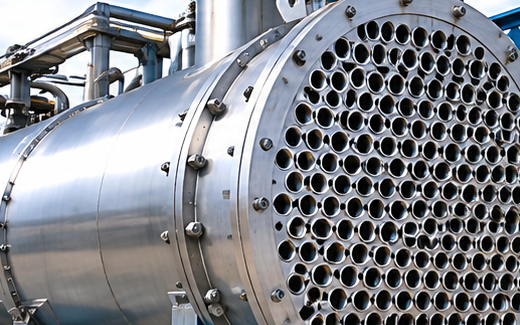
Stainless Steel vs Duplex Stainless Steel
Compare corrosion resistance, mechanical strength and service suitability.
Understand the key differences between conventional austenitic and duplex stainless steel tubes. Evaluate corrosion conditions, mechanical requirements, fabrication and lifecycle costs before selecting materials for your heat exchanger.
Material Basics
Performance Comparison
Service Conditions
Fabrication
Material Selection
Understanding Austenitic and Duplex Stainless Steel


Austenitic vs Duplex Stainless Steel: Key Differences
| Property | Austenitic (304L / 316L) | Duplex (2205) |
|---|---|---|
| Microstructure | Austenite | Austenite + Ferrite |
| Mechanical Strength | Moderate | Higher |
| Chloride Pitting Resistance | Grade-dependent | Generally higher |
| Chloride SCC Resistance | More susceptible | Improved resistance |
| Formability | Good | Higher forming forces |
| Thermal Expansion | Higher | Lower |
| High-Temperature Service | Grade-dependent | More restricted |
Corrosion Resistance & PREN
The Pitting Resistance Equivalent Number (PREN) provides a composition-based comparison of resistance to localized pitting corrosion.
Source: Alleima SAF 2205 seamless tube and pipe datasheet. Published comparison values, not universal grade acceptance limits.
Localized attack that can develop in chloride-containing environments.
Localized attack in restricted or stagnant regions.
Cracking associated with susceptible material, tensile stress and a corrosive environment.
Mechanical Strength & Thermal Properties
Duplex stainless steel offers higher mechanical strength, which may provide design advantages when evaluated under the applicable construction code.
0.2% proof strength at 20°C
| Property | TP316L Reference | SAF 2205 |
|---|---|---|
| Thermal Conductivity at 20°C | 14 W/(m·K) | 14 W/(m·K) |
| Thermal Expansion, 30–100°C | 16.5 × 10⁻⁶/K | 13.0 × 10⁻⁶/K |
Source: Alleima 3R65 and SAF 2205 datasheets. Published material reference values.
Which Material Should You Consider?

Conventional grades for compatible service conditions.
Improved chloride corrosion resistance and higher strength.
Review media composition, concentration and temperature.
Super duplex, titanium or other alloys based on actual conditions.
Fabrication & Inspection Considerations
Review forming forces, bend radius, wall thinning and finished dimensions.
Confirm welding procedures and the required material condition.
Confirm chemical analysis, PMI and any additional testing requirements.
| Standard | Application |
|---|---|
| ASTM A213 | Seamless heat exchanger tubes |
| ASTM A249 | Welded heat exchanger tubes |
| ASTM A269 | General-service tubing |
| EN 10216-5 | Seamless stainless steel pressure tubes |
| EN 10217-7 | Welded stainless steel pressure tubes |
(Where Required)
Initial Cost vs Lifecycle Cost
Related Guides & Capabilities
316 / 316L Material Guide
Review molybdenum-alloyed stainless steel.
S32205 vs S32750
Compare duplex and super duplex grades.
Testing & Inspection
Review inspection and acceptance requirements.
304 / 304L Material Guide
Review material composition and properties.
Need Help Reviewing Your Heat Exchanger Tube Material?
Send your operating conditions, material requirements, tube dimensions and project specification for technical supply review.