The Role of Heat Treatment in Stainless Steel Tube Manufacturing

DLSS - Pipe&Tube - The Role of Heat Treatment in Stainless Steel Tube Manufacturing

Meta Description:
Understand the critical role of heat treatment in the manufacturing of stainless steel tubes. Learn about solution annealing, stress relieving, grain size control, and how these affect tube performance and quality.


Introduction

Heat treatment is not just a step in the production of stainless steel tubes—it is a fundamental quality determinant that affects corrosion resistance, mechanical strength, and long-term reliability.

Whether you’re sourcing ASTM A213 heat exchanger tubes, duplex stainless pipes, or nickel alloy tubes, understanding the heat treatment process will help you ensure material integrity and compliance.


1. Why Heat Treatment Matters

Heat treatment in stainless steel tube production serves several purposes:

  • Restore corrosion resistance (especially after cold working)
  • Relieve internal stresses from forming or welding
  • Refine grain size to ensure ductility and toughness
  • Prevent intermetallic phase formation in duplex and nickel alloys

Failing to apply or verify proper heat treatment can lead to brittle failure, localized corrosion, and poor weldability in service.

Read: Nickel Institute – Heat Treatment of Stainless Steels


2. Common Heat Treatment Methods for Tubes

ProcessPurposeTypical Grades
Solution AnnealingDissolves carbides and restores corrosion resistance304L, 316L, 321, 904L
Stress RelievingRemoves residual stresses from cold formingDuplex, Incoloy, TP347
Bright AnnealingProvides smooth, oxide-free finish in inert atmosphereBA tubes (ASTM A269)
NormalizingRefines grain size, improves uniformityFerritic stainless (TP430)
Aging (Precipitation Hardening)Enhances hardness and yield strength17-4PH, 15-5PH

3. Solution Annealing – The Foundation for Austenitic Tubes

  • Typically performed at 1050–1150°C, followed by rapid water or air quenching
  • Removes strain-induced martensite and carbides
  • Critical for TP316L, TP321, TP904L, and other austenitic stainless tubes
  • Post-bending U-tubes for heat exchangers must be re-annealed per ASTM A213/A269

Key Keywords: solution annealing tube, heat exchanger tube annealing, ASTM A213 tube heat treatment


4. Stress Relieving in Duplex and High-Alloy Tubes

Duplex stainless steels (e.g., S32205, S32750) and nickel alloys (e.g., Inconel 625, Alloy 825) are highly sensitive to improper heat input during bending or welding.

  • Heat treatment prevents intermetallic phase formation (σ-phase, chi-phase)
  • Ensures balanced ferrite-austenite structure
  • Temperature typically ranges from 850–950°C, followed by controlled cooling

Welding duplex tubes without proper post-fabrication heat treatment can result in localized cracking or reduced toughness.


5. Bright Annealing: Clean Surface + Preserved Quality

  • Conducted in controlled atmosphere furnaces (H₂ or N₂-H₂ mixture)
  • Leaves surface bright and oxide-free
  • Ideal for instrumentation tubes, BA finish coils, and pharma-grade tubing

Bright Annealed tubing is widely used in semiconductor, biotech, and high-purity process systems.


6. Grain Size Control & Testing

Fine, uniform grain size (typically ASTM No. 6–8) improves:

  • Ductility
  • Formability
  • Resistance to intergranular corrosion

ASTM E112 is the standard test method for evaluating grain size. MTCs for heat exchanger tubes often include grain size verification, especially for nuclear or petrochemical projects.

Learn More: ASTM E112 Standard Overview


7. DLSS Capabilities in Heat Treatment

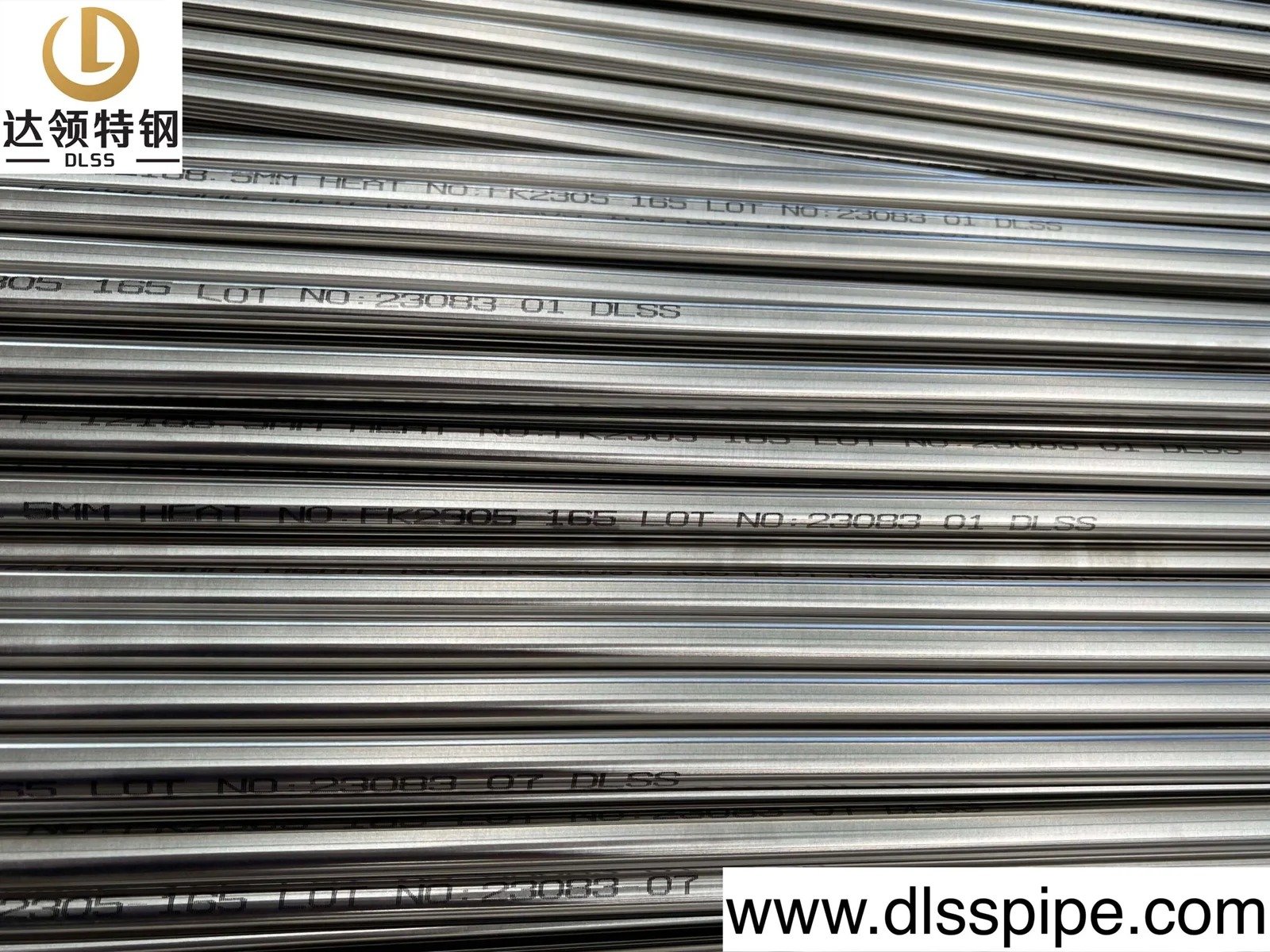
At DLSS, all stainless steel seamless tubes are fully heat-treated in-house using:

  • Hydrogen bright annealing furnaces (for BA tubes)
  • Electric resistance or gas furnaces (for U-bend post-treatment)
  • Verified temperature records and time-at-temperature logs
  • Grain size reports, hardness, and PMI results available on request

Conclusion

Heat treatment is not a one-size-fits-all process—it must be tailored to the tube material, application, and international standard. For engineers and purchasing teams, verifying that tubes have undergone proper annealing or stress relief is essential for performance, safety, and code compliance.


Contact DLSS
Email: info@dlsspipe.com
Website: www.dlsspipeline.com

Looking for stainless tubes with certified heat treatment? DLSS delivers ASTM and EN standard tubes with full thermal traceability and documentation.

Wonderful! Share This Case:

Austenitic Stainless Steel

Duplex Stainless Steel

Nickel Alloys

▪ Incoloy Family

▪ Inconel Family

▪ Monel Family

▪ Hastelloy Family

▪ Other Special Alloys

Cobalt Alloys

Related Posts

How to Accurately Measure Pipe Wall Thickness Using a Micrometer

How to Accurately Measure Pipe

In the manufacturing and inspection of metal pipes—whether stainless steel, carbon steel, or alloy—the wall thickness is a key dimensional parameter. Precise wall thickness affects mechanical strength, pressure resistance, and long-term reliability, especially in critical applications such as heat exchangers, boilers, and petrochemical piping systems. One of the most accurate methods for determining wall thickness […]

Read More

15-Day Delivery of ASTM A182

DLSS recently fulfilled an urgent order for a Dubai-based equipment manufacturer, delivering five 16″ STD CL600 Weld Neck Raised Face (WNRF) flanges made from ASTM A182 F53 (UNS S32750) super duplex stainless steel. Operating in a high-chloride, highly corrosive seawater environment, the client required ASME B16.5 compliance with an exceptionally fast 15-day lead time. Project […]

Read More
Top 10 Materials Used in Industrial Pipeline Engineering

Top 10 Materials Used in

Meta Description:Explore the 10 most common materials used in pipeline engineering, from stainless steel and carbon steel to exotic alloys. Understand their pros, cons, and applications across industries. Introduction Choosing the right material is one of the most critical decisions in pipeline engineering. The material affects not only the strength, corrosion resistance, and temperature tolerance […]

Read More
Green Energy and ESG: How Sustainability Is Reshaping the Stainless Steel Seamless Tube Market

Green Energy and ESG: How

The stainless steel seamless tube industry is undergoing a quiet but profound transformation—not just driven by technical demands, but by Environmental, Social, and Governance (ESG) goals and the global energy transition. As governments, investors, and end-users demand cleaner, longer-lasting, and traceable materials, tube manufacturers are under growing pressure to reduce carbon footprint, improve transparency, and […]

Read More
Stainless Steel Tubes for Heat Exchangers: Grades, Benefits, and Industrial Applications

Stainless Steel Tubes for Heat

Stainless steel has become the material of choice for heat exchanger tubes across a wide range of industries. Its combination of corrosion resistance, mechanical strength, and cleanability makes it ideal for applications requiring durability and thermal efficiency. Choosing the right stainless steel grade is essential to maximizing performance and minimizing lifecycle costs. This article explores […]

Read More
Material Selection for Seawater-Cooled Heat Exchangers: What Engineers Must Consider

Material Selection for Seawater-Cooled Heat

Seawater is one of the most aggressive environments for heat exchanger systems. High levels of chlorides, biofouling, and oxygenated saline water create ideal conditions for pitting, crevice corrosion, and stress corrosion cracking (SCC). Choosing the wrong material for tubes in seawater-cooled heat exchangers can lead to early failure, frequent maintenance, and high replacement costs. In […]

Read More
ASTM vs JIS Standards: Choosing the Right Stainless Tube for Japan(ASTM規格とJIS規格の比較:日本市場向けステンレスチューブの選び方)

ASTM vs JIS Standards: Choosing

1. Introduction In the Japanese stainless steel tube market, buyers often compare ASTM (American Society for Testing and Materials) and JIS (Japanese Industrial Standards) specifications. Both systems have rigorous requirements, but understanding their differences is key to choosing the right stainless steel seamless tube Japan for specific applications such as 熱交換器 (heat exchangers) and 産業配管 […]

Read More
electropolished-tube-id-ra-035

Sanitary Stainless Steel Tubes in

Meta Description:Discover how sanitary stainless steel tubes support hygiene, durability, and regulatory compliance in food & beverage processing plants across South America. Introduction As the food and beverage sector in South America expands rapidly—with leading producers in Brazil, Chile, and Argentina—hygiene and quality control are more critical than ever. From dairy lines in São Paulo […]

Read More

Request A Quote

*We respect your confidentiality and all information are protected.