Spiral Finned Tube vs Extruded Finned Tube: Which is Better for Your Project?

DLSS - Finned Tube Knowledge Hub - Spiral Finned Tube vs Extruded Finned Tube: Which is Better for Your Project?

When selecting spiral finned tube vs extruded finned tube for a heat exchanger, engineers must weigh performance, durability, and operating costs. Both fin types enhance heat transfer, but their differences can significantly affect long-term efficiency.

If you’re new to finned tubes, start with What is a Finned Tube and How It Improves Heat Exchanger Efficiency. For material-specific guidance, see our Finned Tube Material Selection Guide.


1. What is a Spiral Finned Tube?

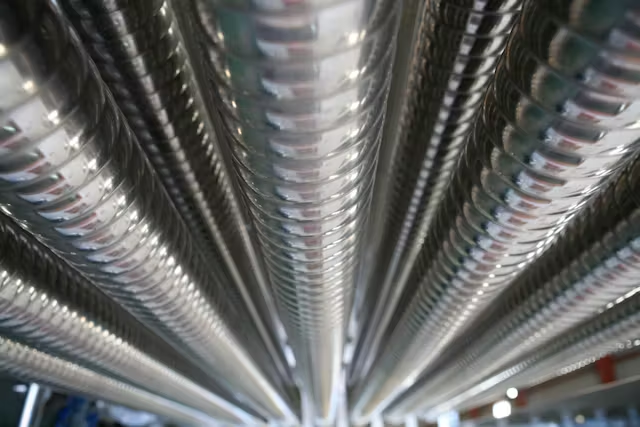
A spiral finned tube is made by helically winding a metal strip (often carbon steel or stainless steel) around the base tube and welding it for a strong mechanical bond.

Advantages:

  • High mechanical strength for high-temperature gases
  • Cost-effective for large heat exchanger projects
  • Excellent for boilers, petrochemical plants, and industrial heaters

Limitations:

  • Lower corrosion resistance than extruded fins
  • Potential for fouling in harsh environments

2. What is an Extruded Finned Tube?

An extruded finned tube is produced by mechanically extruding aluminum or copper fins over the tube surface, creating a continuous bond without welding.

Advantages:

Limitations:

  • Higher initial cost
  • Limited to specific fin materials

3. Spiral vs Extruded: Performance Comparison

FeatureSpiral Finned TubeExtruded Finned Tube
Heat TransferHighHigh
Corrosion ResistanceModerateExcellent
CostLowerHigher
Temperature ResistanceVery HighHigh
Best ApplicationsBoilers, heatersOffshore, seawater cooling

4. How to Choose the Right Finned Tube

  • For high-temperature, budget-conscious projects → choose spiral finned tubes
  • For corrosive or marine conditions → select extruded finned tubes
  • Always consider lifecycle costs, not just initial price

5. Learn More


DLSS supplies both spiral finned tube and extruded finned tube solutions with precision manufacturing and strict quality control.

Contact us today at info@dlsspipe.com or visit www.dlsspipeline.com for a custom heat exchanger finned tube quote.

Wonderful! Share This Case:

Austenitic Stainless Steel

Duplex Stainless Steel

Nickel Alloys

▪ Incoloy Family

▪ Inconel Family

▪ Monel Family

▪ Hastelloy Family

▪ Other Special Alloys

Cobalt Alloys

Related Posts

ASTM B163 Incoloy 825 (UNS N08825) Seamless Tube – 25.4 × 2.11 × 5555 mm, Bright Annealed Surface

ASTM B163 Incoloy 825 (UNS

Product Details Chemical Composition of Incoloy 825 (UNS N08825) Element Composition (%) Nickel (Ni) 38.0 – 46.0 Chromium (Cr) 19.5 – 23.5 Iron (Fe) Balance Molybdenum (Mo) 2.5 – 3.5 Copper (Cu) 1.5 – 3.0 Titanium (Ti) 0.6 – 1.2 Carbon (C) ≤ 0.05 Incoloy 825 is a nickel-iron-chromium alloy with added molybdenum, copper, and titanium for enhanced corrosion […]

Read More
ASME SA213 TP316H Seamless Tube (19.05 × 2.0mm, up to 6000mm in length)

ASME SA213 TP316H Seamless Tube

Product Overview: ASME SA213 TP316H Seamless Tube ASME SA213 TP316H is a high-performance austenitic stainless steel seamless tube specifically designed for applications in high-temperature and highly corrosive environments. Widely used in critical industrial systems such as heat exchangers, boilers, condensers, and high-pressure fluid systems, this material meets the stringent standards set by ASTM A213 / […]

Read More
Exploring Different Types of Pipe-Based Heat Exchangers: Double Tube, Stove Pipe, Exhaust Pipe, and Heat Pipe Designs

Exploring Different Types of Pipe-Based

In various industrial and domestic applications, heat exchangers are essential for optimizing thermal efficiency, reducing energy waste, and lowering operational costs. Among the many designs, pipe-based heat exchangers play a crucial role due to their structural simplicity and high effectiveness. This blog explores four common types: the Double Tube Heat Exchanger, Stove Pipe Heat Exchanger, […]

Read More
Refinery Tube Selection Guide for South American Projects

Refinery Tube Selection Guide for

Meta Description:Need the right tubes for refinery heaters, boilers, or exchangers in Latin America? This guide explains how to choose the best stainless and alloy grades for performance and corrosion resistance. Introduction Refinery operations across South America—whether in Argentina’s Mendoza, Brazil’s São Paulo, or Chile’s Bío-Bío region—require tubing that can handle high temperature, pressure, and […]

Read More
Aluminum Brass C68700 (O61) ASTM B111 Seamless Tube 19 × 1.6mm × 3000mm with 100% Eddy Current Testing for Condenser Applications.

Aluminum Brass C68700 (O61) ASTM

Product Overview: ASTM B111 C68700 Aluminum Brass Seamless Tube (19×1.6mm, 3000mm) C68700 Aluminum Brass, also known as Al-Brass, is a copper-zinc alloy enhanced with a small amount of aluminum. It is widely recognized for its exceptional resistance to dezincification, corrosion, and biofouling, especially in seawater and brackish water environments. This makes it one of the most trusted […]

Read More
TP316L Stainless Pipes for Japan’s Chemical Processing Plants – 日本化学プラント向けTP316Lステンレス管

TP316L Stainless Pipes for Japan’s

Introduction Japan’s chemical industry demands high-performance stainless steel pipes capable of withstanding aggressive media and high temperatures. TP316L stainless pipes by DLSS meet JIS G3459 – Stainless Steel Pipes for Corrosion Resistance, ensuring durability, weldability, and excellent resistance to chloride-induced corrosion common in Japanese chemical processing plants. 1. Why TP316L for Japan’s Chemical Industry(日本化学産業でTP316Lが選ばれる理由) 2. […]

Read More
avoid steel pipe shipment delays

How to Avoid Delays in

In global trade, on-time delivery is just as critical as product quality. For overseas buyers of stainless steel pipes and tubes, shipment delays can lead to project interruptions, financial losses, and strained client relationships. Understanding the common causes of delays—and how to avoid them—is essential for smooth international transactions. Common Causes of Shipment Delays How […]

Read More
Stainless Steel Instrumentation Tubing for Japan’s Oil & Gas Projects – 日本石油・ガス産業向けステンレス計装チューブ

Stainless Steel Instrumentation Tubing for

Introduction The oil and gas industry in Japan demands high-precision stainless steel instrumentation tubing for safe and efficient operation of control systems. DLSS supplies JIS G3446-compliant tubes with excellent corrosion resistance, precision dimensional tolerances, and long service life in harsh offshore and onshore environments. 1. Why Stainless Instrumentation Tubes for Oil & Gas(石油・ガスにステンレス計装チューブが必要な理由) 2. Standards […]

Read More

Request A Quote

*We respect your confidentiality and all information are protected.